

Christbrot or Stollen? Same or Different?
Please note that there are two different hyperlinks in this blog that will take you to Amazon product pages. As of the posting of this blog, we are not an Affiliate of Amazon and will not receive financial compensation for either of these should you choose to follow the link and purchase the product.
There are two kinds of German Christmas bread in my family's memory: the one from the grocery store, and the one Oma risked everything to keep. For five decades, I couldn't reconcile the powdered-sugar-dusted Stollen with the simple, candied-fruit Yule Bread of my childhood. Finally tracking down the origins of Oma's recipe revealed a sad, forgotten truth about why our German traditions were almost lost forever.
A few weeks ago, I was out doing a spot of shopping at that world store where one can find basic packaged ingredients from all around the globe. There, in a Christmas baking display, was a red, hardback volume with the word “Advent” stamped in shiny metallic gold. Soon it was in my hands, and I was poring over the traditional baking recipes of Germany, complete with the food traditions and history. I lost track of time but for the first time, I had an opportunity to track down the origins of Oma’s Yule Bread. What I learned added a little more nostalgia to this Christmas season.
Oma was 22 when World War Two broke out with Germany invading Poland. Out here in rural America, where poor farming families were merely struggling to survive, things could become equally as dangerous. Sadly, due to all the paranoia and hate, much of our food customs and traditions, as well as language, were left behind in favor of personal safety. Only on special occasions were a few recipes produced, but Oma never connected family history with them. It always seemed too hard or uncomfortable for her to recall. However, on Christmas Eve, after church, we went to Oma and Papa’s house for a supper featuring the first smoked sausage retrieved from the smokehouse. On the table with an assortment of pickles and preserves was homemade bread of two kinds. There was plain, soft bread, and then there was Yule Bread.
Yule Bread had preserved fruit and pecans in it. Sometimes it was baked as a normal loaf, and other years it was baked in a coffee can. Preserved fruit. Yes, that garish candied fruit that also finds its way into fruitcake. As a young child, I didn’t like it a lot due to the candied citron and lemon peel. The older I got and the more my palette developed, the more I realized that it was the perfect foil for the rich fried sausage and salty ham. Plenty of Christmas Eve services dressed as a nativity character in the middle of a hot, stuffy, packed church were made bearable by thinking about the feast to come.
Stollen? Back then, Stollen was something that appeared at the grocery store in cellophane packages sometime around Thanksgiving. The loaf was oddly shaped, and I remember young Kimberly thinking that anything with that much powdered sugar on it could not be bad. If I had a chance to be grocery shopping with Oma during that time and found it, I would ask. “Put that back. We don’t eat that,” was the inevitable answer. As young children often do, they stop asking, so by the time they are adults, the questions have been eradicated.
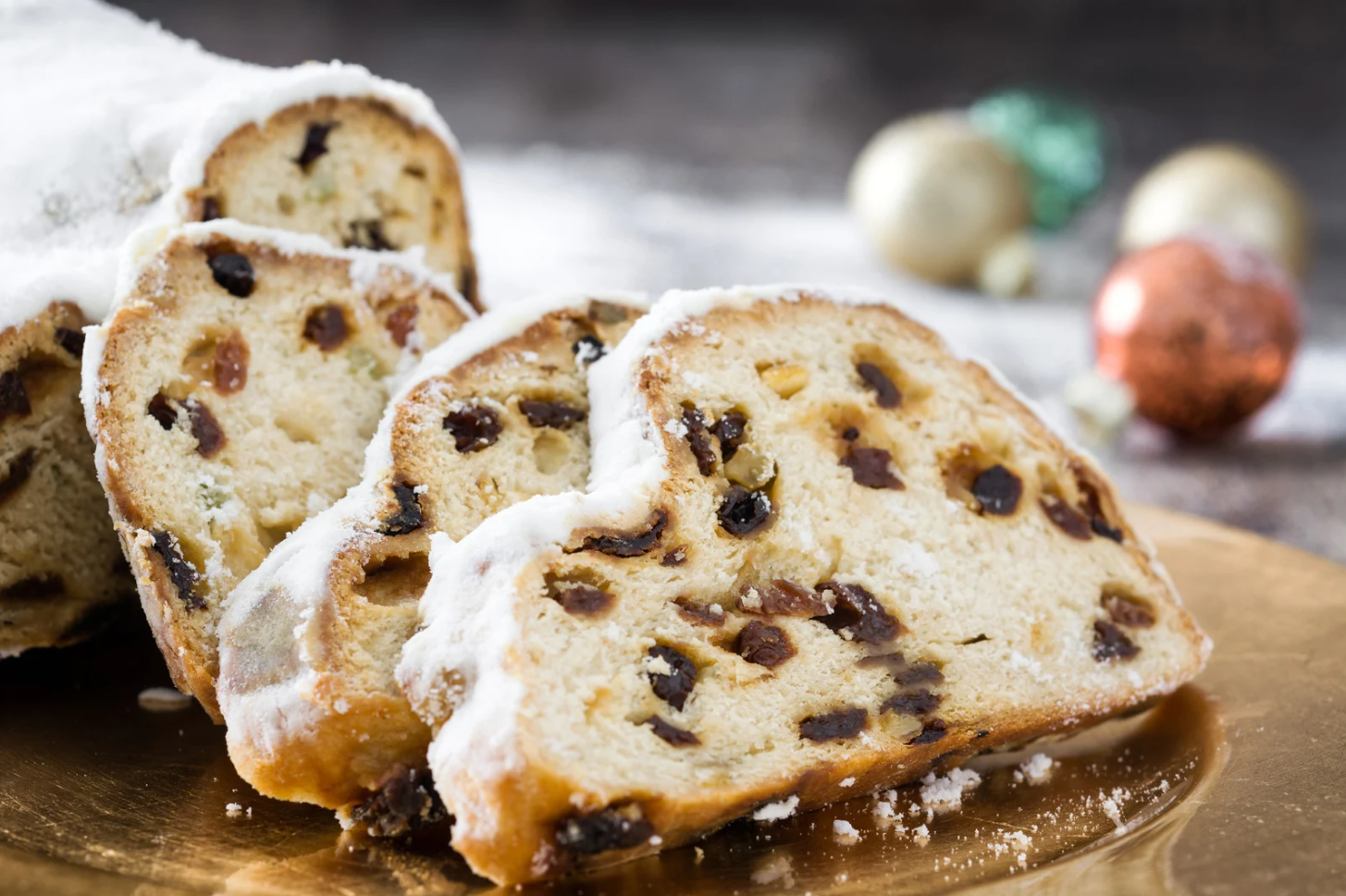
THEN young Kimberly went to culinary school and was introduced to every cuisine on the planet (or almost). The idea of the Christmas Stollen returned to my awareness, facilitated by my second-year pastry instructor. Stollen had spices, orange, and lemon zest incorporated into the dough. It was allowed to rise once before the plumped, dried fruits, the bright red cherries, and nuts were kneaded in. In the final shaping, it received a rope of marzipan tucked into the middle. Bliss! Down-right yeasted bliss. There was no problem identifying that Yule Bread and Stollen were two similar, yet different, yeasted breads.
This year, thanks to a family dynamic that shifted recently, I made both Yule Bread and Stollen. It brought back the old questions, and I was so glad I had found that book. Customarily, Germans do a lot of baking and entertaining during the Advent season. Germans also have traditional weekend meals akin to American brunch, where these beautiful baked goods are shared and consumed.
Honestly, as it is only halfway through December, I may make another batch of Stollen. Dried fruit versus candied fruit makes quite a difference. Let’s go into that topic for a moment before you completely turn up your nose and write me off as “cracked in the head,” at least as far as this blog goes.
Paradise Old English Fruit and Peel Mix has come a long way since my earliest memories in the 1970’s. Back then, the company left a hella lot more “pith” to the citrus peels included in the mix, making it bitter. Today, it is easy to see that the manufacturing process has changed quite a bit as the citrus bits have become smaller. The Mix contains candied orange peel that is natural colored, red colored, and green colored. Additionally, there are citron, red, and green whole candied cherries, and candied pineapple. Honestly, for mine, as the recipe makes three loaves, I much prefer adding two tubs to just the one. Packed with citrus, it is just right for its destiny, partnering with sausage or ham. I find that the bright, varied colors make it a festive item, whether I am having it toasted with my morning tea or using it as a sandwich bread option.
Dried fruit for Stollen: My recipe for Stollen (see below) calls for 450 grams of dried fruit but honestly, I probably put closer to 750 grams in it. I mix the individual dried fruits to suit myself. It has a blend of dark and golden raisins, dried apricots, dried tart cherries, dried cranberries, dates, candied pineapple, red candied cherries, and candied orange peel. The mixture is to be combined with orange juice or rum, covered, and allowed to stand 2-3 hours or as long as overnight. This year, it might have been more like 24 hours since MealScript gets a lot of attention these days. Stollen is a great standalone breakfast, snack, or dessert. Since it comes out more in the shape of a Ciabatta, and has a moister crumb, I do not suggest it as sandwich-making material. However, if toasted, it could likely stand up to a country pate on a charcuterie board.
Finding Advent, by Anja Dunk has given me the first peek into my family’s culture that was lost over hate and the rise of “Canned Soup.” In my untold time perusing this treasure of a book, I learned that Yule Bread (Christbrot) and Stollen are indeed different breads. Further, Stollen is not a hard-and-fast recipe. Stollen is as varied as each family that makes it. It also explained a lot of why Oma “baked up a storm” between the week before Thanksgiving and Christmas Eve. I appreciated learning about customs that I can see carried on until my great-aunts, great-uncles, elder cousins, neighbors, and my grandparents grew old and passed away. Honestly, it is a bit sad that these days we would be offended if anyone showed up for a visit without being invited or at least calling for permission first. Looking back on those drop-in visits, I can see and feel how much love, connection, and friendship flowed through those visits. I can almost smell the propane gas stoves/heaters that warmed the house when lit. Makes me long for a time when telephones were still tied to walls and impromptu games of 42 (dominoes) on a chilly December night were almost better than watching the Bob Hope Christmas Special.
If you are so moved to pick up a new baking adventure this week, here are my Yule Bread and Stollen recipes below:
Yule Bread
Ingredients:
1 cup Milk
1 cup Water
1 Tbsp Active Dry Yeast
½ cup Shortening, melted
1 stick Butter, melted
½ cup White Sugar
3 cups All Purpose Flour
1 tsp. Granulated Table Salt
1 cup Pecans, Chopped
2 pkg. Paradise Old English Fruit Mix
Instructions:
Melt shortening and butter in the microwave, and warm milk (can use oatmilk or almond milk) and water to no warmer than 100 degrees Fahrenheit. Place in the bowl of a stand mixer. Take the temperature of the mixture and confirm that it is no warmer than 105 degrees Fahrenheit before adding the yeast. Allow the yeast to hydrate and proof for about 10 minutes.
While the yeast is blooming, chop the pecans and place them in a medium-sized bowl with the two packages of candied fruit mix. Sprinkle with 1 cup of the flour and mix to combine. This will keep the pieces separate and distribute more easily through the dough.'
Add half a cup of sugar and 2 cups of flour to the proofed yeast and mix well (5-7 minutes). Cover the bowl and let it rise in a warm, draft-free location until doubled in bulk. Add the fruit and nut mixture and another cup of flour to the dough and mix until the dough comes together and cleans the sides of the bowl. **Do not be afraid to add a little more flour, about a tablespoon at a time, until the dough comes together if it is too wet.
Preheat oven to 350 degrees Fahrenheit.
Grease a large mixing bowl and place the dough in it. Cover the bowl with plastic wrap or a tea towel and let rise until doubled. Divide the dough into 2-pound loaves, shape them, and place them in greased bread pans to rise again to double in size.
Bake in a preheated oven for 45 minutes or until the loaves are pulling away from the sides of the pan and the internal temperature is 195 degrees.
Remove from oven and allow to cool 10 minutes before removing to a cooling rack to continue cooling.
Christmas Stollen
Ingredients:
Fruit: place in small/medium bowl, mix, cover, and allow to macerate for 4 hours and up to 24 hours:
750 grams Dried Fruit (dark raisins, golden raisins, diced dried apricots, dried tart cherries, dried
Cranberries, diced dates, diced candied pineapple, candied red cherries, candied orange
Peel, and candied ginger).
¼ cup Dark Rum (substitute all juice if you do not care for alcohol)
¼ cup Orange Juice (can also use apple juice- the goal is enhancing the fruit flavor)
Dough:
1 Tbsp Instant Yeast
¾ cup Water, warm (no more than 100 degrees F)
1 x-large Egg
8 Tbsp Butter, super soft
28 grams Non-fat Dry Milk [¼ cup] (full-fat okay too)
420 grams All-Purpose Flour [3.5 cups measured]
50 grams Granulated Sugar [¼ cup]
6 grams Table Salt [1 tsp]
1 tsp Cardamom, ground
1 Tbsp Lemon zest, fresh
71 grams Toasted Almonds, chopped [½ cup]
Filing:
287 grams Marzipan or Almond Paste [approximately 1 ¼ cups]
Topping:
2 Tbsp Melted Butter
As Desired Confectioner’s Sugar or Snow White Non-Melting Sugar (donut sugar)
Instructions:
Prepare the fruit:
Weigh out the dried fruits and combine with rum and/or orange juice. Cover the bowl with plastic wrap and allow to macerate for 4 hours, and up to 12 hours (though 24 hours did not have an adverse effect on the product).
To prepare the dough:
Measure the water and yeast into the bowl of a stand mixer.
Add the egg and allow the yeast to hydrate while preparing the flour for the dough.
Weigh the flour or measure it by sifting the flour, then gently spooning it into the measuring cup, sweeping off the excess with an offset spatula.
Add the flour to the bowl along with the butter, dry milk, sugar, salt, cardamom, and zest.
Using the dough hook for the stand mixer, knead together until it forms a smooth, soft dough.
Cover and let rise for 60 to 90 minutes or until doubled.
Filling:
Divide the marzipan into three equal pieces and roll each into a log about 7 inches long. Flatten slightly.
Assembling the Stollen:
Grease a clean work surface and turn the dough out, flattening it.
Knead the fruit and almonds into the dough.
Divide the dough into three equal parts and shape each into an 8” by 6” oval.
Place the marzipan down the longer center of each oval, folding over lengthwise, and leaving the top edge just short of meeting the bottom edge.
Press the top edge firmly to seal the marzipan into the dough.
Place the loaves on a parchment-lined baking sheet, cover them, and let them rise 45 minutes to 1 hour until puffy.
During the final rise, preheat the oven to 350 degrees Fahrenheit with the rack placed in the middle of the oven.
Bake the stollen for 30 to 35 minutes until golden brown and an internal temperature of 190 degrees Fahrenheit on a digital thermometer.
Remove the stollen from the oven, and brush with melted butter. Allow to cool 5 minutes before dusting with powdered sugar.
Transfer to a cooling rack to cool completely and prevent the bottoms from sweating.
Wrap tightly and store at room temperature for 2 weeks. The bread will hold longer if frozen.
From our homes to yours, Happy Hanukkah, Merry Christmas, and a Blessed holiday season, however you choose to celebrate the festivals of light. May your New Year be filled with new hope, love, and memories to treasure.
Peace, Love, and Chocolate
Kimberly
#GermanBaking #ChristmasStollen #HolidayBaking #OmasRecipes #Christbrot #TraditionalBaking #AdventRecipes #ChristmasBread #HeritageCooking #BakingHistory
